|
|
 |
|
|
GHEORGHI ARNAOUDOV
THE EMPIRE OF LIGHT
Gheorghi Arnaoudov: The Empire of Light. A. Tosheva - piano. Concord Concerto CCD-42032 - 56:40 ‘ Produced by Heiner Stadler. Ritual I "Svarog Rituel"). Ritual II ("Incarnation dans la Lumière"). “...un pan de ciel au mileu du silence...”, Partita I.
Elsewhere in this issue I discuss the common fallacy of mistaking the technique used to create art for the art itself. On most of the music groups on the Internet, as well as in the pages of most publications devoted to music, one will often encounter someone who describes the music of this century as a colossal washout, generally ascribing its failure to Schoenberg and his successors. The recording under review poses an interesting conundrum for such a view as the Bulgarian Gheorghi Arnaoudov (b. 1957) could accurately be described as a postserialist but the sound of his music, which is the thing after all, has nothing in common with serial composition. The present release, which comprises his complete piano music, is apparently his debut on CD. I should say straight out that I love the music on this CD and I will undoubtedly become tiresome to my friends and family in my insistence that they MUST listen to this music. Describing what this music is like is more problematic.
The promotional materials emphasize Arnaoudov's minimalist credentials and urge that route as a means of promotion. Eric Salzman, whose writings on new music I have enjoyed for twenty-five years, stresses the mystical aspect of Arnaoudov's art in his informative and entertaining liner notes, likening the music as filling the silence like the smoke from a ritual fire fills the air. The result is to seemingly forge a bond with the Eastern Europeans Part and Gуrecki. Then there is that serialist connection I mentioned earlier. With due respect to Salzman and the wizards of promotion at Concord, I hear the music as emerging out of Messiaen and Scelsi. Throughout the glorious, reverberant piano sound reinforces this notion and perhaps offers another route to Arnaoudov's music for listeners.
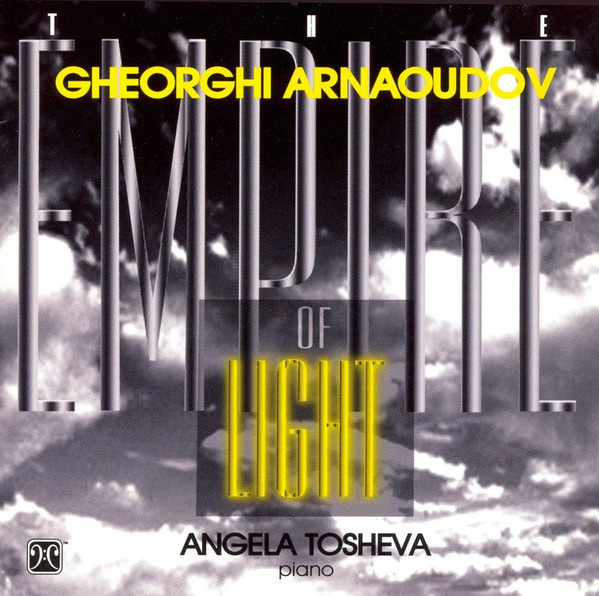 Throughout bell sounds permeate the music. The two Rituals and the three pieces that make up Un pan de ciel au mileu du silence... (A piece of sky amid silence after paintings by Magritte), dating from 1991, 1992, and 1991-94 respectively, represent five ways of doing essentially the same thing. All five pieces refer to light in their titles (the second of the Un pan... pieces is the title track, The Empire Of Light). The music begins on a single tone, usually a D, either soft or loud, and then builds to include all twelve notes of the scale. Eventually the music dies back to the single tone, usually marked ppppp, before it returns to silence. Vestiges of serial conceptions remain. The twelve tones don't all appear before a repetition but once they do, they always appear in the same order. There is no transposition of the row although tones are combined with one another as well as shifted in register so both the harmony and melody are constantly shifting. Throughout, he uses the reverberating overtones as ornamentation to the basic notes, building great structures of what Stockhausen, in his piano music, has referred to as colored silence. The tendency to build his rows in thirds and fifths means that there is always a sense of sonorous chords, as opposed to clusters, in the music. There is a definite sense of no way qualified to address the specific spiritual qualities involved, the sense of something larger going on is present here as much as it is in Bruckner.
Having said all that it is something of a shock to reach the last piece on the program, the early Partita I from 1983, which is described by Salzman as being actually serial, and discover virtually all of Arnaoudov's current obsessions present in his try at a neo-Classical suite. Of the five movements (Prelude, Recitative, Aria, Toccata, and Fugue) only the last bears any resemblance to more conventional music.
Without scores one has to accept the accuracy of the performances on faith. The piano is a gorgeous instrument and, as recorded in Sofia's Salle Bulgaria, Angela Tosileva's tone is something to behold. Urgently recommended.
John Story, Fanfare Magazine January/February 1997
For the press (PDF)...
© 2020 - 2023, Gheorghi Arnaoudov
© 2020 - 2023, Paintings by Yassen Panov
Contact e-mail: garnaoudov(at)gmail.com
| | | |


